The Easy Way to Understand IP44 Bathroom Lighting
An IP44 rating means a light fitting is protected against solid objects over 1mm in size and against water splashes from any direction.
In UK bathrooms, IP44-rated lights are required in Zone 2 (the area within 60cm of a bath, basin or shower).
This guide explains where you need IP44 fittings, where you can use standard ones, and how to choose the right lighting for every part of your bathroom.
Whilst there are areas where IP44 rated fittings are essential or highly recommended, often a standard fitting (IP20) will suffice – giving you a much greater scope when choosing the right fitting.
To ensure clarity around what you are shopping for, it is crucial to understand the regulations concerning bathroom lighting.
UNDERSTANDING IP RATINGS
PROTECTION LEVELS- FIRST DIGIT
PROTECTION LEVELS – FIRST DIGIT
The first digit in the IP rating system indicates the level of protection against contact with moving parts (excluding components like smooth rotating shafts) and the prevention of solid foreign objects from entering the equipment.
Understanding this first digit is essential for ensuring both personal safety and the integrity of the equipment’s enclosure.
| 0 | No special protection |
| 1 | Protection from contact with a large part of the body, like a hand (but not deliberate access), and from solid objects larger than 50mm in diameter. |
| 2 | Protection against fingers or other objects up to 80mm in length and 12mm in diameter. |
| 3 | Protection from entry by tools, wires, etc., with a diameter or thickness greater than 1.0mm. |
| 4 | Protection from entry by solid objects with a diameter or thickness greater than 1.0mm |
| 5 | Protection from the amount of dust that would interfere with the operation of the equipment. |
| 6 | Dust tight. |
PROTECTION LEVELS- SECOND DIGIT
Protection Levels – Second Digit
The second number in the IP rating indicates how well the internal components of the enclosure are protected against various types of moisture, including dripping, spraying, and submersion.
Understanding this digit is vital for ensuring the durability and safe operation of the equipment.
| 0 | No special protection |
| 1 | Protection from dripping water. |
| 2 | Protection from vertically dripping water. |
| 3 | Protection from sprayed water. |
| 4 | Protection from splashed water. |
| 5 | Protection from water projected from a nozzle |
| 6 | Protection against heavy seas, or powerful jets of water. |
| 7 | Protection against immersion. |
| 8 | Protection against complete, continuous submersion in water. |
IP EXPLANATION AND RATINGS
The international standard EN 60529 provides a globally recognized classification system to rate the protection level of electrical equipment enclosures against the entry of foreign objects (such as tools, dust, and fingers) and moisture. This system, known as the Ingress Protection (IP) rating, uses a format where ‘IP’ is followed by two or three digits (for example, IPX4 focuses solely on moisture resistance, with ‘X’ replacing the digit for foreign object protection). Occasionally, a third digit is included to provide additional information about protection.
Understanding and adhering to these ratings is crucial for maintaining electrical safety and functionality.
WHERE DO YOU NEED IP44 LIGHTS IN A BATHROOM?
Which are the areas where IP44 lights need to be used?
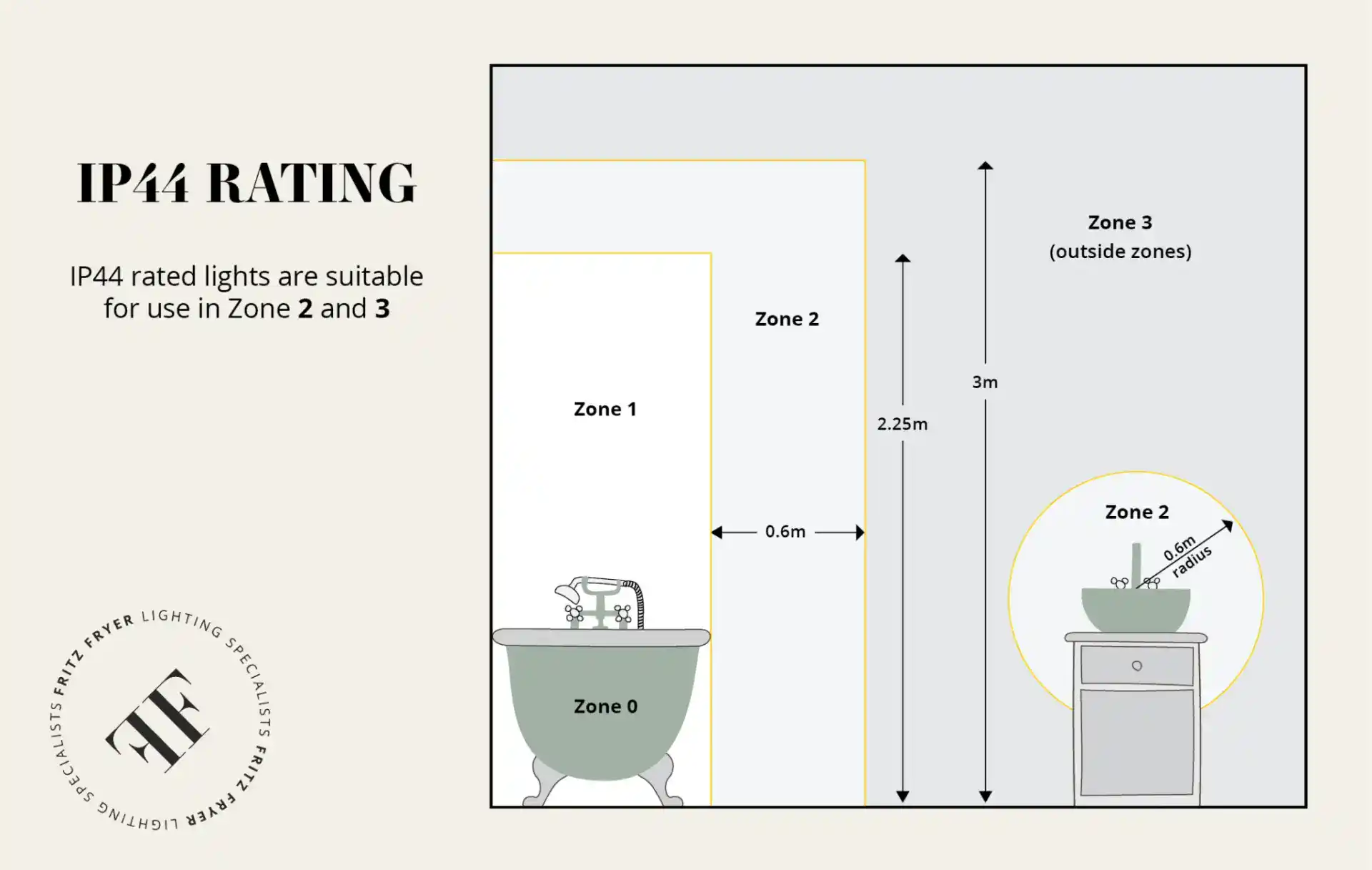
Below is a diagram showing the different bathroom zones.
According to the UK wiring regulations, lights installed in Zone 2 must be IP44 rated or higher. Zone 2 is the area within 60cm of a bath, basin or shower, up to 2.25 metres high.
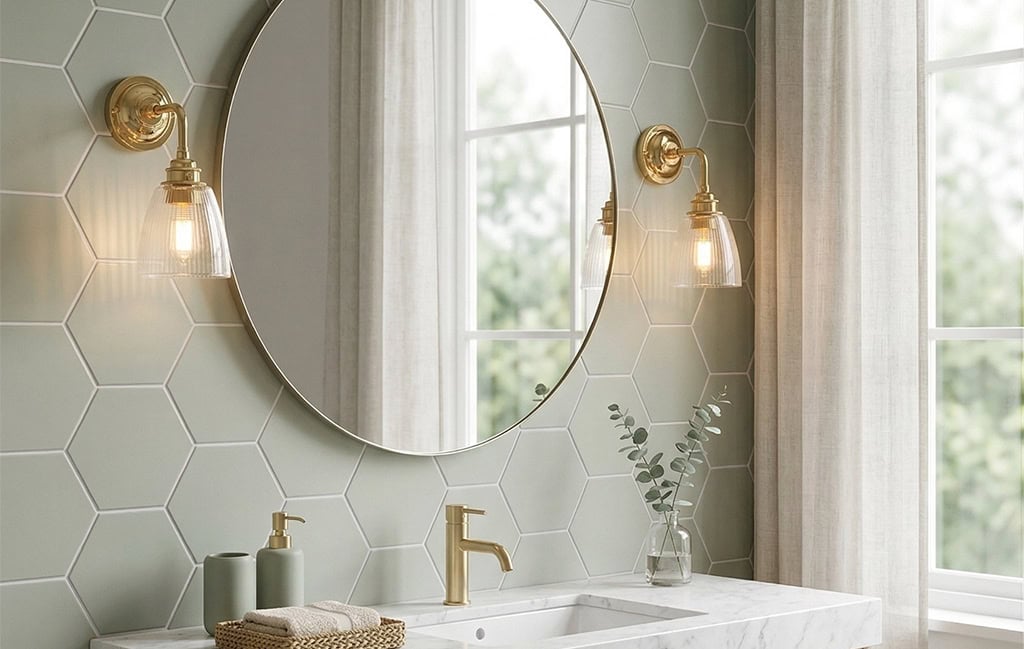
If you want to put lights on either side of a mirror, position them just outside Zone 2 (more than 60cm from the water source) and standard IP20 fittings become an acceptable choice
It is worth noting that common sense should be applied, especially if it is a public space or if children are likely to use the room, and it is always worth taking the advice of an electrician.
IP44 Rating & Bathroom Zones Diagram
Zone 0 and Zone 1 are the most heavily regulated when it comes to safety.
Zone 0 covers submerged lights which must be completely immersion proof. Zone 1 is the area right above the bath, up to 2.25 metres from the floor, where IP65-rated lights are recommended.
For Zone 0 (inside the bath or shower itself) fittings must be fully immersion-proof, typically IP67. For Zone 1 (directly above the bath, up to 2.25 metres high) IP65-rated fittings are recommended.
Outside the defined zones there are no specific IP requirements, but common sense and an electrician’s advice should always guide the choice, especially in public spaces or where children use the room.
HOW TO USE NON-IP44 LIGHTS IN A BATHROOM?
Keep in mind that not every light fitting installed in a bathroom will necessarily need to be IP44 rated. The level of protection required depends on its precise position in relation to the bath or shower and the likelihood of it being exposed to splashing water.
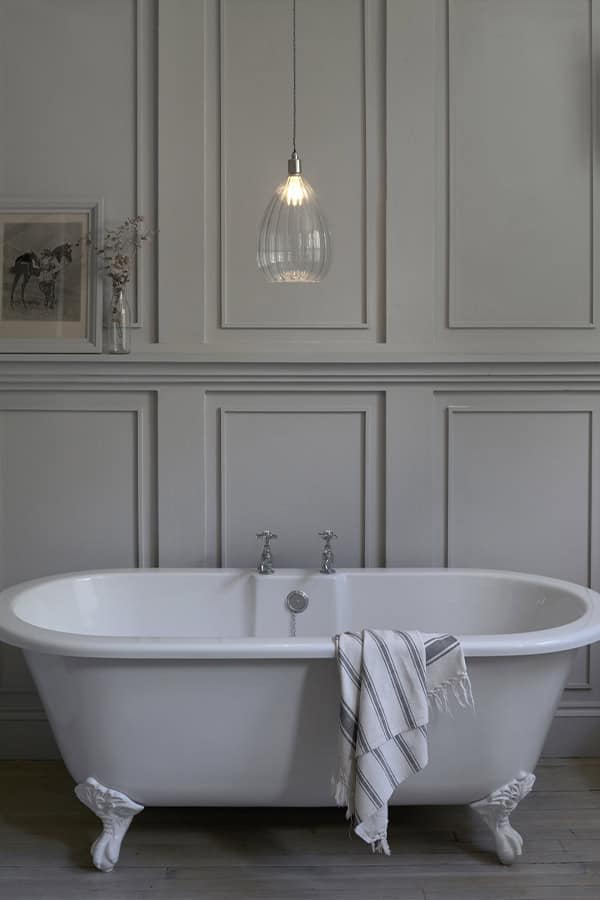
If you have your sights set on a decorative bathroom pendant, its positioning may make a difference. For example, shortening the flex could potentially position the fitting outside the prescribed bathroom zones. However, bathroom zones must be measured accurately, and moving a fitting by only a few centimetres should never be assumed to make it compliant.
A generously sized shade with a smaller opening may provide some additional physical shielding from occasional splashes. However, a shade does not alter the fitting’s certified IP rating and should not be treated as a substitute for the appropriate level of ingress protection.
Bathroom electrical requirements depend on the individual room, the position of the fitting and the way the space will be used. Always speak to a qualified electrician before selecting or installing bathroom lighting—and seek professional advice if you have any doubt at all about whether a fitting is suitable for its intended location.
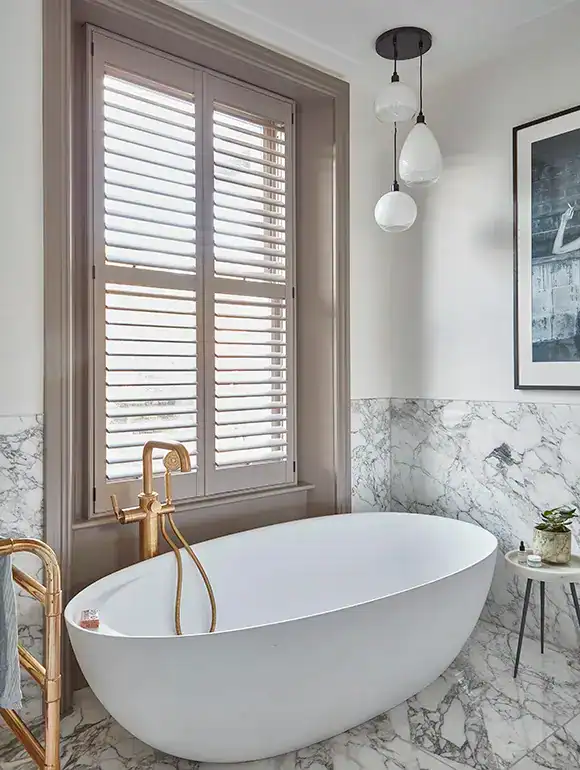
Product: Grafton Pendant Light
CAN WE CONVER LIGHTS TO IP44?
Most of our lighting fixtures can be adapted for bathroom use, even if they aren’t specifically part of our bathroom lights range.
IP44 VS STANDARD WALL LIGHTS: WHAT IS THE DIFFERENCE?
Watch this video as Callum explains the key differences between our IP44 wall lights and our standard wall light collection.
If a light on our site catches your eye and you’d like to have it converted for bathroom use, please contact us to enquire!
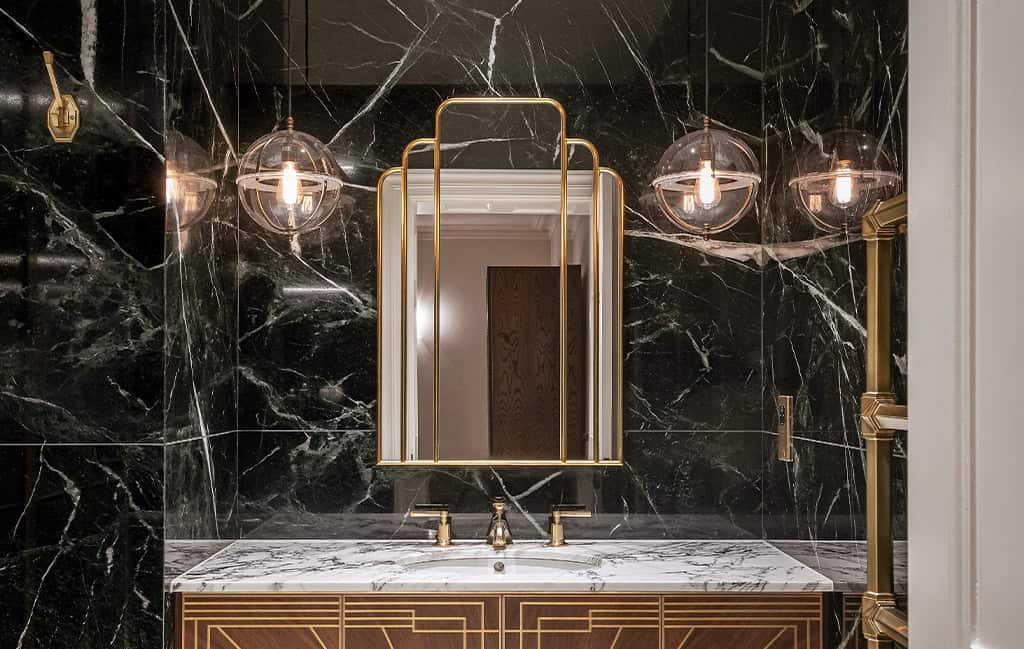
Bathroom installers often insist on using only IP44 lights, regardless of whether regulations allow for other types. However, knowing the rules and understanding how to use non-IP44 lighting in your bathroom will enable you to question their recommendations. Always prioritise safety and be sensible, but if you want a beautiful chandelier and have enough ceiling height to place it outside of Zone 2, go for it!
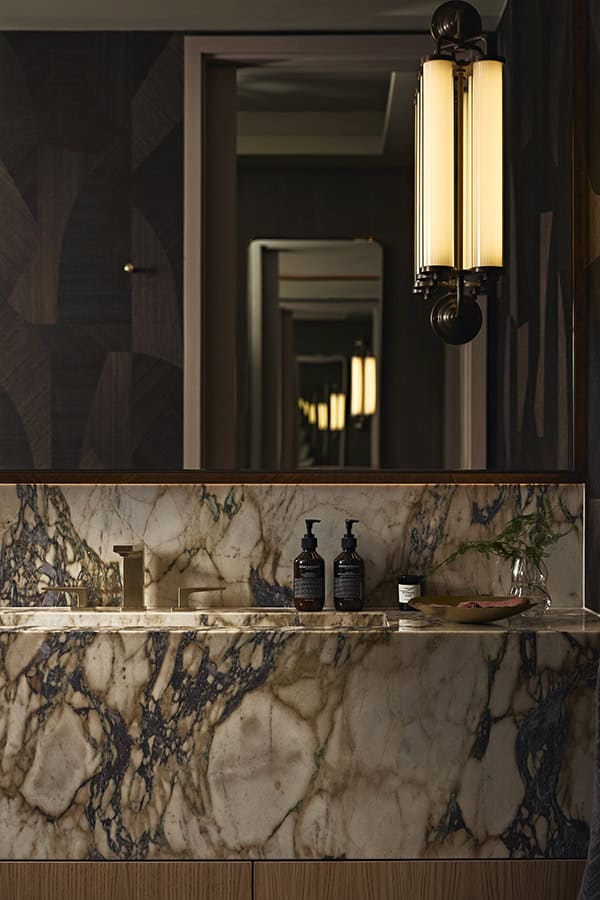
Product: Alton wall light – 2 tube
Image credits: @godrich_interiors, @jondayphotography
We hope you can benefit from the tips we shared and help you save money on your bathroom lighting installation! If you have any questions or are unsure about which lights to choose, don’t hesitate to get in touch!
BATHROOM ZONE OVERVIEW
Zone 0 | Inside the bath or shower, any fitting in this zone must be low voltage (maximum 12V) and rated at least IP67, which means it is completely immersion proof. |
Zone 1 | Above the bath or shower, up to a height of 2.25 metres, fittings must have a minimum rating of IP44. However, using IP65-rated bathroom lights is often recommended for better protection against water jets. |
Zone 2 | The area extending 0.6 metres outside the perimeter of the bath and up to a height of 2.25 metres from the floor requires fittings with a minimum IP rating of IP44. |
Outside Zones (Beyond Zone 2) | The area extending 0.6 metres outside the perimeter of the bath and up to a height of 2.25 metres from the floor requires fittings with a minimum IP rating of IP44. |
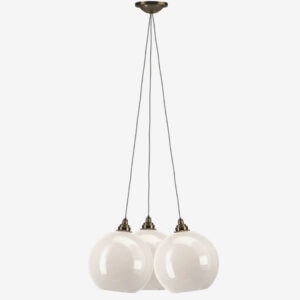
Product: Bathroom Cluster Lights
IP44 VS IP65: HOW THEY COMPARE
When choosing bathroom lighting you will most often see IP20, IP44 and IP65 ratings mentioned.
Here is what each one means and where each is appropriate.
| IP20 | IP44 | IP65 |
Protection against solid objects | Objects larger than 12mm (like fingers) | Objects larger than 1mm (like small wires) | Fully dust-tight |
Protection against water | No protection | Splashes from any direction | Low-pressure water jets from any direction |
Where you can use them | Living rooms, bedrooms, hallways, kitchens (away from sinks) and outside all bathroom zones | Bathroom Zone 2 (within 60cm of a bath, basin or shower), utility rooms, sheltered outdoor spaces | Bathroom Zone 1 (directly above the bath), shower enclosures, exposed outdoor spaces |
Also suitable outdoors? | No | In sheltered locations only, such as under a porch | Yes, in exposed locations |
Typical bathroom use | A hallway light just outside a small ensuite | Wall lights beside a bathroom mirror, a bathroom pendant | A downlight directly above a bath or shower |
FREQUENTLY ASKED QUESTIONS ABOUT IP44 BATHROOM LIGHTING
Does the whole light fitting need to be IP44 rated, or just the bulb?
The whole fitting needs to be IP44 rated, not just the bulb. The IP rating refers to the enclosed fitting as a complete unit (the housing, the seal around the bulb, and the electrical connections). Fitting a standard bulb into a standard fixture in a bathroom Zone 2 area will not meet the regulations, even if the bulb itself is water-resistant.
Can I use non-IP44 lights outside Zone 2 in my bathroom?
Yes. Outside the defined bathroom zones there is no legal requirement to use IP44 fittings. As long as the light is more than 60cm from the edge of a bath, basin or shower, and not directly above them, standard IP20 fittings are compliant. This means for a spacious bathroom, you have far more design freedom than you might have been told.
What is the difference between IP44 and IP65?
IP44 and IP65 both offer water protection but at different levels. IP44 protects against water splashes from any direction, making it suitable for Zone 2 in bathrooms. IP65 protects against low-pressure water jets, making it suitable for Zone 1 (directly above the bath) and for exposed outdoor use. If your fitting will be somewhere it might be sprayed directly with water, choose IP65. If it will only encounter splashes and steam, IP44 is enough.
Do I need IP44 lights in a shower room without a bath?
Yes. The regulations apply to any bathroom or shower room, whether or not there is a bath. Zone 2 extends 60cm from the edge of the shower area, and any light within that zone needs to be at least IP44 rated. Zone 1 rules also apply directly above the showerhead.
Can I install IP44 lights myself, or do I need an electrician?
In the UK, bathroom electrical work is classed as notifiable under Part P of the Building Regulations. This means it should be carried out by a qualified electrician, or notified to your local Building Control body. Even if you are confident with wiring, the safety implications of getting bathroom electrics wrong make an electrician the sensible choice.
Are IP44 lights suitable for outdoor use?
IP44 fittings can be used outdoors in sheltered locations, such as under a covered porch or in a car port. For fully exposed positions, such as garden walls or open patios, choose IP65 or higher, which will withstand rain and low-pressure water spray. Our outdoor lighting range includes options for both sheltered and exposed positions.
IN SUMMARY
UNDERSTAND BATHROOM ZONES
Knowing where moisture and splashes are most likely helps determine where IP44-rated lighting is required for safety and compliance.
FOLLOW PROTECTION LEVELS
IP44 lights protect against solid objects and water splashes, making them ideal for many bathroom locations.
DESIGN WITHOUT COMPROMISE
Safety doesn’t mean plain; IP44 lighting comes in a variety of styles, from classic wall sconces to modern pendants.
ENHANCE BOTH SAFETY AND STYLE
The right fitting can transform your bathroom into a space that is functional, compliant, and visually appealing.
IP44 BATHROOM LIGHTING INSPIRATION
Explore our Top 10 Stylish IP44 Bathroom Lights for a curated selection of beautiful, bathroom-ready designs.
READY TO CHOOSE YOUR BATHROOM LIGHTING?
-

Ledbury Contemporary Bathroom Wall Light
£347.10 – £399.00Price range: £347.10 through £399.00 Inc VAT Select options This product has options that may be chosen on the product page -

Hay Bathroom Pendant Light
£373.20 – £525.90Price range: £373.20 through £525.90 Inc VAT Select options This product has options that may be chosen on the product page -

Hereford Bathroom 3 Way Dish Cluster
£1,102.50 – £1,296.00Price range: £1,102.50 through £1,296.00 Inc VAT Select options This product has options that may be chosen on the product page